This blog lost its purpose in the past few years, but has kept my best memories since at least 2005. In 2001-04, I was on Tripod, and a pMachine blog on this current domain!
Probably because of the most active years (2005-2008), I've posted a total of about 1200 times on smurfmatic.net, woaw.
In this era of social blogging, here's where you can find me:
Twitter: https://twitter.com/cedricsam
LinkedIn: https://www.linkedin.com/in/cedricsam
Weibo: https://weibo.com/cedricsam
From 2007, I had a blog on Chinese stuff. But since I now live in China (Hong Kong, actually), it would seem a bit irrelevant to keep updating. But I still do, occasionally.
Comme les Chinois: https://commeleschinois.ca/
I've also started blogging more seriously on work-related stuff. So, for that, I will use Tumblr:
https://electricricecooker.tumblr.com/
(In 2010-12, I was hosted on my employer's domain: https://jmsc.hku.hk/blogs/ricecooker/)
Finally, I also have a portfolio that currently lacks some updating:
https://cedric.sam.name/#portfolio
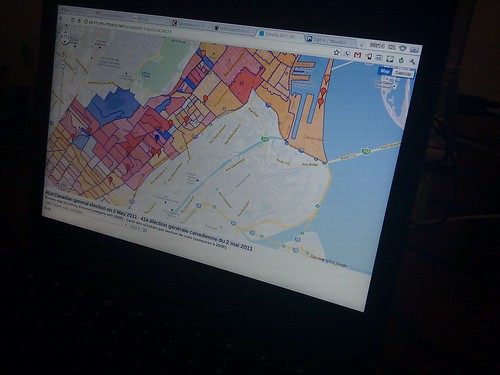
https://earth.smurfmatic.net/canada2011/polls/
Update (2011-10-16): Indeed, I've now added the political parties layers (the colors represent the proportion of votes by a party over the total number of votes) and a voters' turnout layer (nb of votes compiled over the nb of registered voters). If there are problems in interaction or information layout, please tell the interaction designer (me).
I finally got around last week to update my election maps to 2011. The new interface now lets you get the maps in good old 2-D Google Maps if your system doesn't support the Google Earth plugin.
The new version also lets you compare layers between each other. For now, I'm only offering the default "margin of victory" map for 2008 and 2011. Pretty soon, I will post maps specific to parties and the turnout rate. You are welcome to submit ideas of other geographic analyses.
Also, I've decided to release the code for this project to the open on GitHub.
Ce soir, j'ai essayé de regarder les Perséides, en vain. Contrairement à l'année dernière, alors que nous étions à Lamma, cette année, je suis à Montréal à la mi-août. Les choses ont beaucoup changé, et j'ai l'impression que ce fût l'année où j'ai consolidé mes assises à Hong Kong.
Cette année, je n'étais pas au milieu de la jungle (urbaine et rurale) de Hong Kong, mais plutôt au milieu de la banlieue montréalaise, chez mes parents et mes grands-parents. J'ai peut-être vu que deux étoiles filantes pendant la demi-heure passée sur la terrasse derrière la maison de mes grands-parents, sans rien voir, car les lumières du voisin shinaient un peu trop fortement.
La chanson des Cowboys fringants vient rappeler de l'ephémérité de la vie. Qu'il faut profiter de tous les moments, au risque de ne pas assez vivre. Il faut faire des erreurs, et ça prend probablement des échecs pour être heureux. Être heureux, c'est peut-être aussi un état d'esprit. On ne peut peut-être jamais être totalement heureux, et ce qu'il faudrait c'est d'être plus heureux?
Août 2010 a été déterminant dans l'année qui suivit. J'avais decidé le mois précédent de retourner à la maîtrise, et allait bientôt commencer mes cours et rencontrer un nouveau groupe de personnes. À ma job, je venais aussi d'être affecté à de nouvelles tâches, qui allaient me permettre de réaliser des choses qu'on s'attendait de moi à mon embauche en 2009.
Durant l'année, j'ai continué à faire des événements Beer Bay hebdomadaire, durant lesquels j'ai fait connaissance de ma petite gang québécoise, depuis lors désintégrée.
En 2011-12, je sais que j'aurai un nouveau groupe avec moi à la maîtrise. Je sais que mon contrat de travail aura à être renouvellé. Je sais aussi que ça sera l'année déterminante, l'espèce de point d'inflexion pour la carrière que je souhaiterais avoir. J'ai hâte de voir comment ça se passera.
***
Ça fait depuis deux semaines que je suis revenu de Hong Kong. C'est la plus longue période pour laquelle je suis de retour au pays, et par le fait même, les plus longues vacances prises depuis fin 2009.
Je me sens bien et reposé. Ça fait changement du Cédric stressé, qui avait hâte d'atteindre le bord de la piscine. J'ai hâte de recommencer.
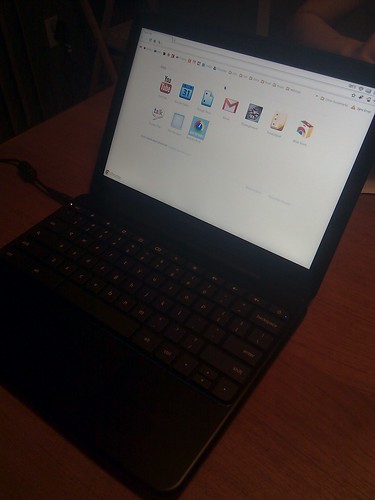
I just received my Samsung Series 5 Chromebook. First impressions... There's going to be a little bit of getting used to the lack of desktop. It's basically like Google Chrome, the browser, but taking the entire space of the computer. Aesthetically, there are added icons at the top right of the Chrome for time, wifi signal, battery and other Chrome instances. It's fast, but there's going to be some learning curve for doing stuff like listening to music, editing videos and opening terminals...
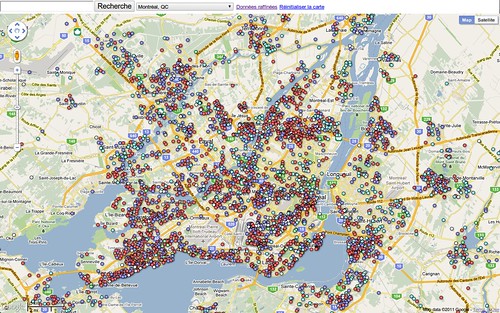
After a few sleepless nights, the political financing map (carte des contributions aux partis politiques) is finally out.
The great thing about doing this project is that we started with what is supposed to be public data and made it actually public. We downloaded it, refined it and mapped it. Although I didn't get around to posting the geocoding results, essentially all the raw data of about 500,000+ entries is made available to the public through Google Fusion Tables. I even used the data I extracted to create my own non-Cyberpresse visualisation (en français).
I think the amount of data displayed will be overwhelming to anyone. Users of the map will be interested to see around places where they live and places that they know, so I think it will be a great platform for crowdsourcing too. I hope you enjoy the map!
Dernière d'une série de trois, voici un tracé de la provenance des contributions faites aux partis politiques et associations de circonscription en 2009. L'outil d'où proviennent ces captures d'écran sera publié tard vendredi soir, heure de l'est. Samedi matin, la surprise sortira.
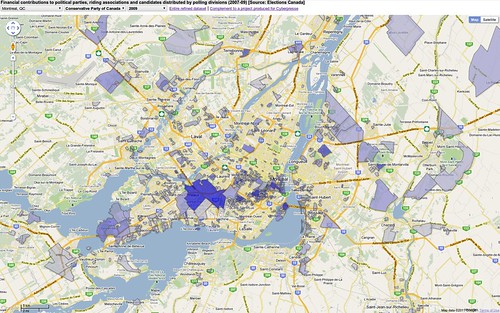
Parti conservateur
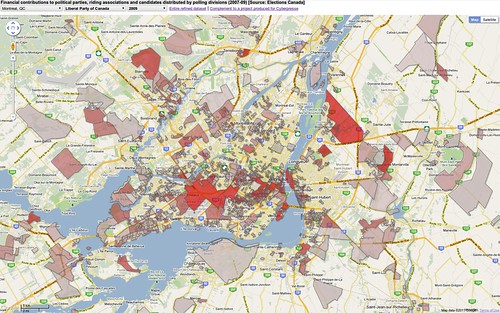
Parti libéral
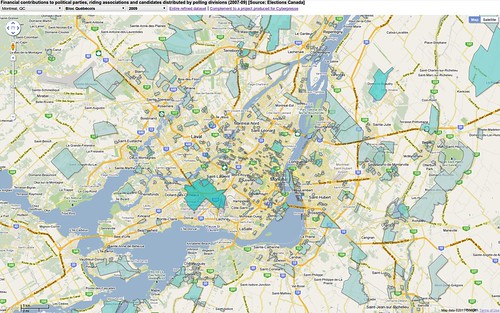
Bloc Québécois
(Les dons au NPD et au Parti vert dans la région métropolitaine sont trop minimes pour être montrés ici.)
Like I did for Toronto, but this time for Vancouver.
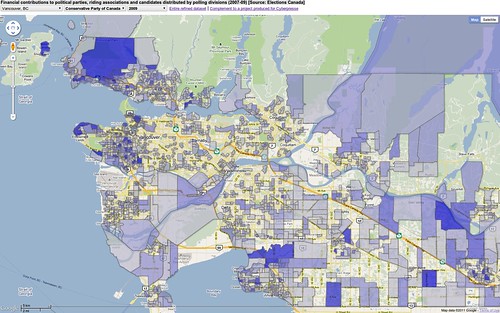
Conservative Party
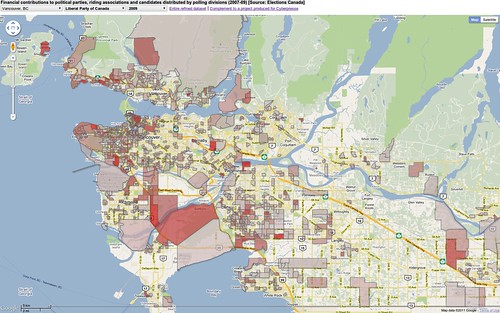
Liberal Party
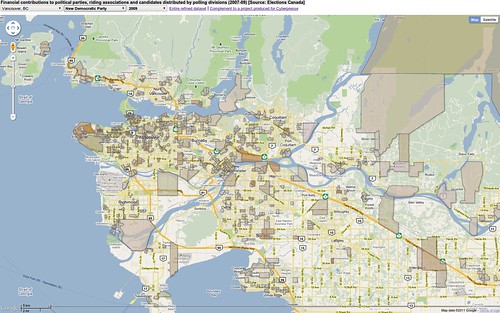
New Democratic Party
These are the compiled financial contributions to national instances of political parties and riding associations for 2009, distributed among polling divisions (from postal codes of contributors, geocoded when possible). The data was obtained from Elections Canada's website. More to come later, links to come later.
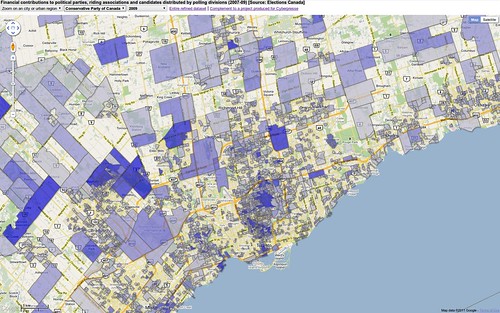
Conservative Party
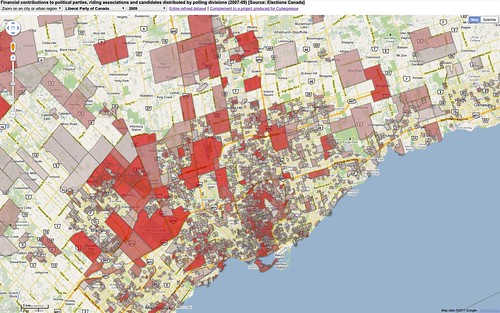
Liberal Party
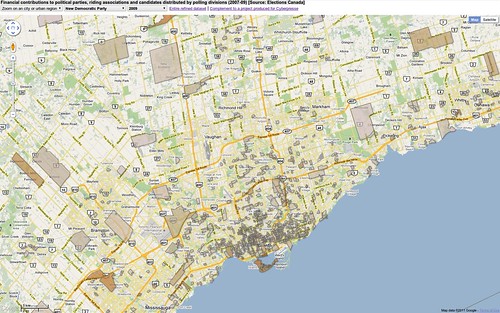
New Democratic Party
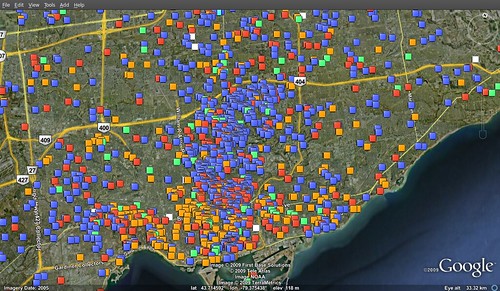
Sometime in early 2009, I came up with the Canadian electoral financial contributions project. At the time, I thought it would be awesome to do something with the data that Elections Canada, an independent federal agency in charge of conducting elections and referendums in Canada, releases publicly about funders of political parties. The website contains different ways to access the information, whether it is political party or riding association annual returns or by candidate's expenses during an election.
I wrote a basic how-to, pointing out how obfuscated the browsing of the data was. You can technically download CSVs of the data, but Elections Canada's servers would time-out if you asked for the entire dataset at once.
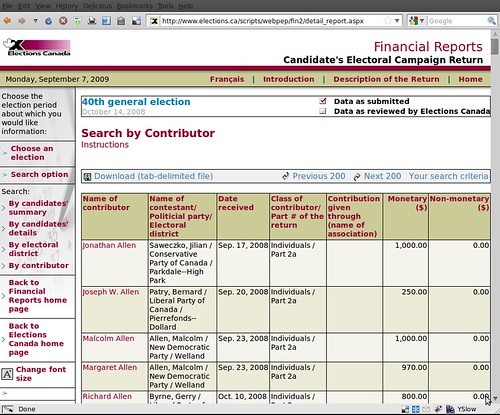
Try to do mashups with this
There were also some cleverly hidden public data that consists in the postal code of a single contributor. Using a Web browser, it was impossible to compile this data into a database. But using simple scripts with a command-line tool like curl, it was possible to know the location that a donor used to make its donation, including private residence. It might be of questionable good taste to reveal those on a map, but in an era of data mashups and visualisation, it makes perfect sense for what is after all public data.
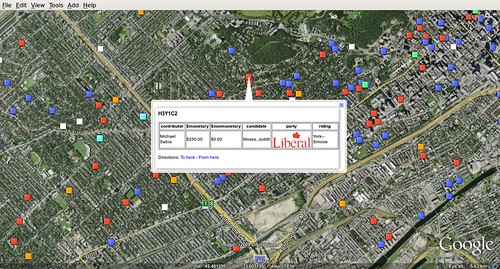
Michael Sabia (Caisse de dépôt et placement du Québec President / CEO) gave money to the Liberals
At the time, I demonstrated my method with only 2008 data and let the project die for lack of interest and time. In the meanwhile, I moved to Hong Kong and started a new career over here, and have been working on data projects.
Now that elections are looming in Canada, and with an improved skill set, I've unearthed the project a week or so ago, and started really digging into it since yesterday. I already reached the stage of collecting all the 2007-2009 data from annual transaction return, and the postal codes of contributors. I am now geocoding the postal codes and will be thinking of ways to offer a better filter and search the data. Aside from mapping the data geographically, I think that it would be interesting to show trends in the data, of where the money went, etc. For the public, it would be interesting to offer a focus on where celebrities and important people put their money, just like the Huffington Post's Fundrace did in the US.
---
Update 2011-04-16: This is the raw data
Well, what are assignments good for in grad school, if we don't get to publish them anywhere? So here it is, the first assignment that I did for our first seminar course at SD PolyU in interaction design.
***
(The original article can be found here)
Assignment One
Using an existing product type, discuss at least three kinds of data that one may select for observation. Explain where you think each kind of data may lead one in an investigation of the nature of interaction.
The Twitter application for Android by Twitter Inc.
Illustrations 1 & 2: The Twitter application for Android
For this assignment, I will be considering the official Twitter app on the Android platform. It is one of the applications that I use the most on my mobile handset.
In the study of interaction design, we are looking at the relations between humans and objects. These "objects" are often computing devices, including the software which runs them or on them, because of their malleability and ubiquity.
To paraphrase Google's choice of name for its first branded phone, these handheld machines and their apps are communication "nexuses" between us and other people. The information that we put on the Internet is our medium of communication. In particular, the Twitter application lets users sign on, find and read, write and contribute to the Twitter network. Twitter in turn acts as a "media" where other people pool, analyze and derive information that is important to them.
For this assignment, we may be immediately interested in the interaction with the application, but in turn, we may more generally see it as an interaction with other people, via the Internet.
Clearly, I think that one of the first "data" that we have to look at is flow and hierarchy of the system. By this, I mean the way that this program is organized, and what logical steps a user must go through to accomplish what he came to the app for. The interaction may be initiated when the user voluntarily clicks the Twitter icon in his application launcher or when a notification draws his attention to the Twitter app (more on this later). The user is initially brought to a screen of six main icons and a bird figure that "tweets" trending topics on Twitter (see Illustration 1), and is further led down to more states with more streamlined potential functions. If he leaves the program to do something else on his device, he may be brought back to the same state when he decides to come back to it.
Another data that I would investigate is feedback and notification. In a sense, this Twitter application talks to us, the users. Without this response from the application, we would have trouble talking back to it. For instance, a sound notification may be triggered by incoming "direct messages" or "mentions" of our Twitter username by other users when the app runs in the background. Some types of feedback may popup messages (like the one seen in the mid-bottom of Illustration 1) when an error has occurred, such as a failed tweet when the network is unavailable.
Illustration 3: The Twitter app's settings menu
Coupled to response is the idea of controls. I define controls as the user input destined to change and modulate his interaction with the application. Controls are the icons that change the state of the app and they are the clickable areas when I read my friends' tweets. However, they are also in my mind the app's settings box, which lets us set up the amount and the kind of response to expect from the app.
Flow and navigation is what we are doing with our ship. Whereas controls let us steer around the app, feedback and notifications let us know where we are -- and whether we've hit a reef.
J'aurais dû m'en douter que les Perséides se voyaient mieux dans l'hémisphère nord. La constellation de Persée ne se lève qu'après 22h à la latitude de Hong Kong.
Vendredi soir, le 13, je suis sorti prendre une marche de minuit dans la jungle de Lamma.
Derrière le stand à tofu-dessert, j'ai pris le chemin qui longe le champ d'aubergines qui va jusqu'à la plage de la centrale électrique, car elle est juste à côté justement d'une central électrique (au charbon) qui alimente une bonne partie de la ville. C'était difficile de voir les étoiles, tant les lumières de la centrale scintillaient. J'y suis resté quelques instants, et j'ai repris le chemin vers l'autre plage, celle aménagée par le département du loisir.
La route entre les deux plages était en béton, assez large pour des camions (quelque chose que Lamma n'a pas, en général, sur ses routes), mais sans lampadaires. C'était ma première fois dans une jungle, la nuit, je me suis dit. Pas la jungle profonde, mais quand même. Une chance que j'ai amené ma grosse lampe Maglite, laissée dans l'appart par le locataire précédent.
Il y a trois ans, j'étais allé voir les étoiles au Mont St-Hilaire pour la fête de quelqu'un que je ne connaissais pas. C'était une belle soirée, même si j'ai fini par dormir sur le sofa de la cabane du centre de recherche/retraite McGill louée par l'amie de mes amis. Probablement que ça a été la meilleure récolte de tous les temps en étoiles filantes...
***
Hier soir, j'ai eu de la belle visite sur Lamma. Les amis avec qui j'étais venu sur l'île pour la première fois étaient de retour pour célébrer la fête d'une de nos amis. Ça me donne l'occasion d'émettre la réflection très profonde que, wow, les choses ont bien évolué en une année. Il y a dix mois à peine, je venais d'arriver à Hong Kong, sans emploi, pas certain si j'aurais une chance de revenir à mon ancienne job à Montréal. Et aujourd'hui, je pourrais me dire que, quoique ce n'a rien de la stabilité à Montréal, j'ai quelques assises solides sur lesquelles bâtir.
Je pense que mes amis savaient que j'aurais aimé que tout le monde reste, comme tout le monde savait que notre ami américain voulait ses smores. :D Mais bon, je pense que sur toutes les choses qu'on voulait collectivement, il y en avait certaines qui n'étaient compatibles avec les désirs de tous et chacuns. Le problème des groupes nombreux...
Ce « bon temps » comme la chanson des Cowboys frigants chantent, c'est peut-être maintenant et plus jamais ? Peut-être qu'en vieillissant, on devient moins flexible, moins ouvert sur notre conception du bonheur, des bons moments de la vie ? Un peu trop heavy là.
C'était le premier vrai get-together chez moi, en tout cas, je voulais dire. Et comme c'est pas si facile que ça se rendre à Lamma, je suis quand même content d'avoir pu rassembler tout le monde pour voir ces fameuses (ou foutues) Perséides, même si elles ne se sont pas du tout pointées, à cause surtout des lumières intenses des bâtiments autour de la plage publique (toilettes, etc.). On a quand même allumé un petit feu, qu'un gars qui travaillait p-ê pour le département du loisir nous a crié quelque chose qui nous a fait comprendre que c'était interdit et qu'il était la personne en position d'autorité icitte.
Le monde a quitté sur le ferry de 23h30, le dernier qui sort de Lamma de la nuit, avant celui du matin à 6h40. C'est dommage qu'il n'y ait plus de traversier de nuit, comme c'est le cas pour d'autres îles extérieures plus peuplées. Comme j'ai oublié mes clés prêtées à un de mes visiteurs, j'ai dû attendre le retour du ferry à 1h, quand un matelot me les apporta. Avec une note qui dit que c'était pour 沈先生 (M. Shen), une faute commune sur mon nom de famille, qui est 岑 (Cen -> Sam).
Je suis rentré chez moi à 1h10, épuisé, plein de sable sur toutes les parties de mon corps, et j'ai pris la douche que je voulais prendre une heure et demie auparavant. Je suis ensuite allé sur mon toit, chasser les étoiles filantes. Et j'en ai pas vu une seule, puisque le voisin shinait ses grosses lumières sur sa terrasse en brassant quelques parties de Mah jong.
Finalement, je pense que la conclusion serait qu'on a eu du bon temps, malgré le manque d'étoiles filantes. Quand je suis rentré, j'ai pensé à cette chanson populaire québécoise. Le band de garage de mon frérôt la joue, mais qui est probablement marquante pour les gens de notre génération, et étrangement (ou pas) aussi pour nos amis anglos néo-montréalais.
(Peut-être je me souviens de ma conversation en juin à Montréal avec une amie, qui en conclusion aurait pu se terminer sur la pensée que plus on recherche le bonheur, moins on le trouvera... Alors, eille, faut juste chiller un peu plus. En tout cas, c'est une réflection qui sera bonne pour plusieurs!)
Probably one of the most improbable flights I've done (aside from HKG-CAI) that I'll be doing tonight.
I don't know. Maybe this break from my life in HK will do much much good. Living on Lamma is already a daily break, but perhaps the general breathing space of North America will also do good.
I'm also only gone for a week -- just enough to adjust to jet lag (will be v. happy to pop the melatonin pills).
Did I pack too much? Probably.
I'm a little nervous -- have no specific idea why.
Flight's at 22:45. Will arrive at 20:30 in SFO. Will have traveled 2 hours in the past. Yay!
Once in a while, it's good to put down an assessment of things of the moment.
So, this week marks pretty much the seventh month I am in Hong Kong, and not sixth month as I thought. For some reason, it doesn't seem that long, but seven months is a long long time. You do a lot of things in seven month. Two more months and it's as long as it takes to carry a baby!
The weather's getting really humid. I've lived on my island for a little more than six months, and it's still rather enjoyable. The ferry, however, makes my social life less prone to late-night improvisations. Weekends on the island feel like being in a resort town: the calm and quiet, birds chirping, dogs barking, and of course, tourists bustling.
Work is about what I am expecting, at times very intense, and at times a little less intense. Getting the impression that I am doing something important, which I've always wanted to do; and of being at the right place, at the right time. Enjoying my time there as well.
How has my life changed from September 2009 until today? I have a mobile phone with broadband Internet access. I take the ferry and minibus every day, rather than use my legs to propel myself (on a bike). I feel that 18 Celsius degrees is cold weather. Everyone is Chinese and speaks Chinese. :O I think that hk$100 (ca$14) is overly expensive for dinner at the restaurant. And a bunch of other things.
There is more subtle stuff, I'm sure, but that'll be for another day...
I guess that my interests have changed too, and things that I thought were important or which had a particular interest to me (Chinese indie music) has been evened out by different factors.
I don't think I'll elaborate too much on people, but the people I've met have been great in general. People relationships, but also institutions, groups, whatnot, also seem to be of a different ballgame altogether, because of volume and amplitude. Montreal is just not an international city, while Hong Kong is. Because of that, I often feel like here, right now, is the real thing. It's the major league, to follow the sports metaphor.
I wonder how you would feel or felt about moving to a different city for the first time?
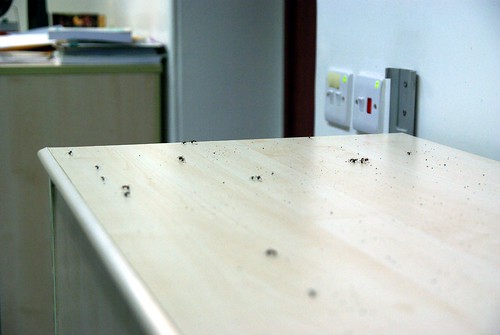
We have this weird problem with the air conditioner at the office. Whenever you turn on the AC, 30 seconds after the fan starts, big black ants start spewing out of the mouth. I think the outside pipe might be too close to the ground, the ants made a colony in the pipe, or they are collecting the dirt accumulated in the AC (which was recently cleaned, actually). But this afternoon, when we turned on the AC, instead of the 4-6 blown out, 25-30 actually came out. Let me just tell you it was quite a messy extermination...
Ok, so after being the official vendor of the Hero in Hong Kong, the Android platoform's former flagship handset is now proposing to hand you HK$4280 if you bring them your Nexus One and sign a monthly contract of HK$398 for two years. That's HK$410 with the fee.
If you bring a phone to them, you sign a 18-month contract and would pay for HK$250 (238+12) a month. If you do the maths, say if we extend this contract to 24 months, you would pay $6000 (250*24) at the end of it. With the other plan, it's HK$9840 (410*24), minus the rebate it's HK$5560.
So the longer contract by six months, and the special plan for Nexus Ones, will save you some 440 over two years, or about HK$19 a month.

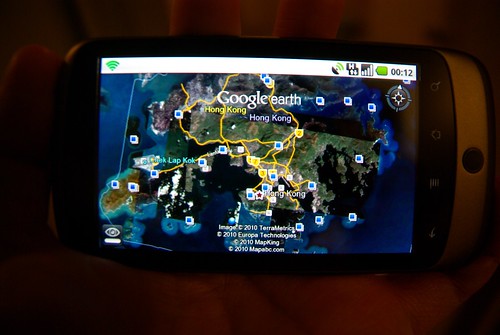
Since February 22nd, Google Earth is available on certain Android handsets, including the Nexus One. Just like Google Goggles, it's a neat app that you want to show all your friends without a Nexus One -- but not a terribly useful one. I wrote a review piece for Vox Asia this week, detailing my thoughts on the N1.
Je viens de changer le plan de données illimité de mon téléphone pour me permettre de faire du tethering et ainsi m'alimenter en Internet chez nous. Du coup, on m'a donné le Access Point (APN) du broadband résidentiel qui s'appelle juste "Internet". Et ça me coûte que HK$50 (CA$6.50) de plus par mois, et un beau total de HK$300 (CA$40) par mois.
Donc, à part que je puisse maintenant faire du tethering avec mon cell (j'aurais pu aussi avant, mais ça aurait contrevenu à mon entente), le nouvel APN me donne constamment de plus grandes vitesses de transfert de données et me permet maintenant aussi de streamer de l'audio à travers le réseau mobile.
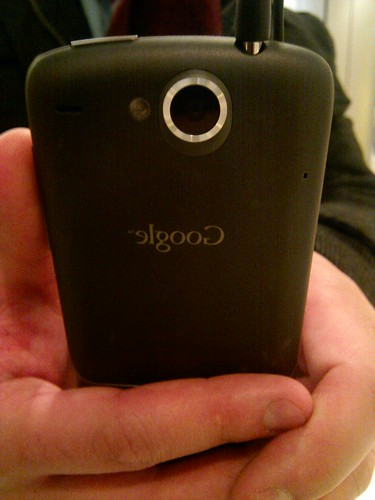
Armé de mon Nexus One (que je vais reviewer la semaine prochaine), je peux donc me promener dans la rue à Hong Kong et écouter les streams de Radio-Canada (et de CBC, de Bande à part, etc., par extension) comme si j'étais à Montréal! Le seul hic: c'est à travers le réseau 3G, alors ça va drainer de la batterie.
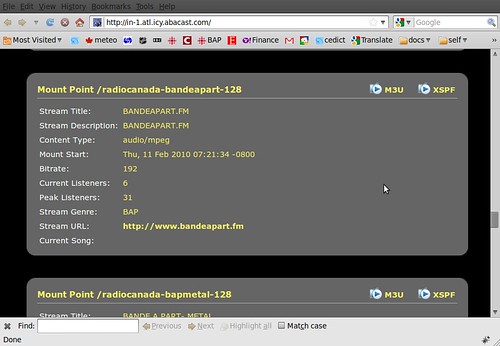
En fouillant dans les fichiers Javascript de BAP, j'ai trouvé que le serveur des publishing points chez Abacast servait aussi une page index: https://in-1.atl.icy.abacast.com/. C'est aussi peut-être un alias/serveur géo-spécifique de https://icy1.abacast.com/ que j'ai trouvé dans les ASX de R-C.
CBC et Radio-Canada sont de leurs partenaires et la liste de la page mentionnée ci-dessus comprend donc pas mal tous les mount points de ses feeds audio, servis pour appareils mobiles, applications Web, etc.
Comme c'est public, on peut pointer à ces addresses directement sur son browser mobile, et si la connection est assez rapide (devrait être HSDPA, à 3Mo/s), on peut les écouter comme de la radio à travers les ondes. On va sur la page, on copie le lien M3U, et on enlève le ".m3u" de l'adresse (ou on ouvre le fichier m3u dans un éditeur de texte).
Des streams taggés "128" (comme ceux de BAP) sont en fait du 192kbps. Ça tire un peu beaucoup avec ma connection sur l'île chez moi, mais quand ça marche, ça sonne mieux que la radio FM. Y'a d'autres streams comme les radio musicales qui sont aussi à haut débit. Le talk radio est à 64.
Autre goody: la page nous montre le nombre d'auditeurs présentement connectés. (Bon, ça serait p-ê une bonne idée que qqu dise à Abacast d'arrêter de laisser cette page publique?)
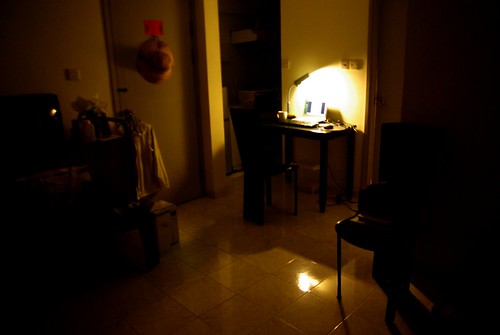
I got a new desk lamp tonight. I really like it and I think it changes the whole atmosphere in my apartment. Now, instead of having the chandelier weakly illuminate the entire living room, I can shut down the lights in the whole flat and have my lamp focus on my desk only.
Back in Canada, I used to have a weaker lamp, but which did almost the same effect of letting me dim the surroundings. It's rather soothing, and comforting at night, especially when bringing back work home.
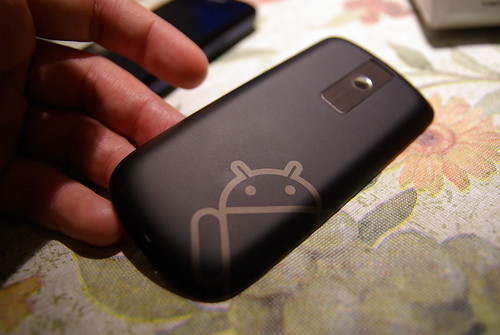
Android Dev Phone 2 cover. The AD2 is also known as the Google Ion, a software remix of the HTC Magic. Was handed out to Google I/O 2009 attendees and made available to other developers in November 2009.
When Google's new "superphone" Nexus One was released yesterday, it was made available for online orders shipping to four places in the world: the US, the UK, Singapore and Hong Kong.
In Canada, I was paying CA$40/mo for high-speed (7mbps) Internet over fixed-line, on top of a mobile phone service (no data) that costs me CA$35/mo.
Hong Kong is a city where you can get pay-as-you-go SIM cards for your GSM phone with a company like China Mobile HK for just HK$100 (CA$13.50) and get charge HK$0.10 (just above one cent) per local minute, and HK$0.25 (about three Canadian cents) per minute for Overseas calls to places like Canada, the US and the UK. If you sign up for a monthly postpaid plan (need a HK ID, or pay a ~HK$3000 deposit), you can get ridiculously cheap plans. My family and friends here constantly tell me about plans going for HK$50-100/mo. (CA$6-15), giving them access to stuff like 1000 minutes, up to a practically unlimited amount of minutes to call to Canada.
But one of the reason -- I think -- making Hong Kong such an appealing market for Google to roll out its version of the future (in the cloud) is also the cheap price of mobile broadband.
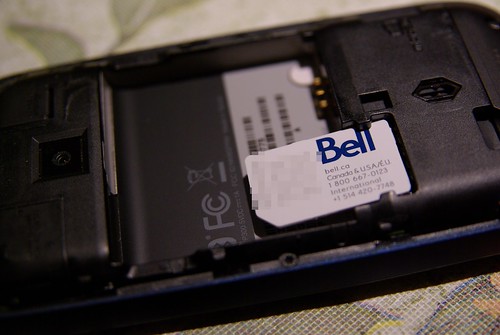
Android Dev Phone 2 with a SIM card from Bell (Canada).
Back in Canada, all major phone companies offer mobile Internet, but always with some sort of limitation on the bandwidth. Bell released its new HSPA+ network in Fall 2009, with potential speeds up to 21mbps (that's 3 times as fast as the typical high-speed Internet by fixed phone line), but typical speeds going much lower, probably running at 3-7mbps (just speculating). The price? A regular 500Mb data plan for iPhone goes for CA$50. That's not a lot of data, if you consider that each video watched on YouTube can be 5-10Mb. Other Bell data plans range from CA$60-100 for bandwidths of 1-3Gb.
Now in Hong Kong, I am also a personal consumer (I don't get any phone, let alone phone plan from any company that would employ me), and recently switched from a prepaid plan with China Mobile HK (the lowest of the low in HK, but a v. good short term prepaid option) to a postpaid data plan with SmarTone-Vodafone, probably the company with the next to the best (CSL/Telstra) mobile network coverage and quality in Hong Kong. Now this plan sets me back HK$250 (all fees included) and gives me unlimited data (and an insane to Canadians, but expected by Hongkongers, amount of minutes) at typical speeds of around 2-3mbps.
Now, bear in mind that in this market, HK$50 monthly plans are the norm for the masses. But with a comparable cost of living to Canada (3/4 of Canada in daily expenses), this means that with tethering (using your phone as a modem for your computer) for an extra HK$50, for a total of HK$300 (or CA$40), people in Hong Kong can drop their fixed Internet line altogether, and like to paraphrase Google, merge their phone with the Web for ridiculous prices for North American wallets.
Unlimited high-speed data plans are sold by 3 or 4 companies in Hong Kong, with prices varying around HK$250/mo, the price at SmarTone-Vodafone with a 18-month contract. The selling point, at least for me, was that you can break your contract at any point for just a HK$500 (CA$66) fee.
Is that the sign that mobile phone contracts are starting to become a thing of the past? The plan is again very poorly advertised by SmarTone, because subsidized phones are still the way. This HK$250 monthly contract is only available if you bring your own unlocked smartphone, very common in Hong Kong... and now available directly from Google at US$530, or US$580 (HK$4500) when counting an AC adapter and international shipping to Hong Kong.
If your needs don't justify such expenses, Hong Kong is probably one of the easiest places in the world to find second-hand phones of reliable quality (this is not the jungle of Mainland China). One of my friends went to Mong Kok and bought a "used" HTC Tattoo (came out just in October 2009), HTC's budget-range smartphone that is running Android 1.6 for only HK$1000-something (around CA$200 if I remember correctly).
250/mo becomes 3000/yr (CA$400), for all your Internet needs. When I'm going to read these numbers in 5 years, I'm probably going to be as amazed as what a regular laptop or desktop computer used to cost 5 years ago...
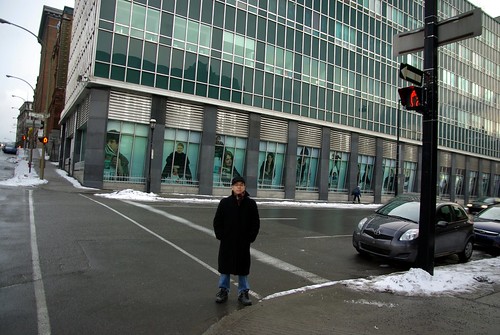
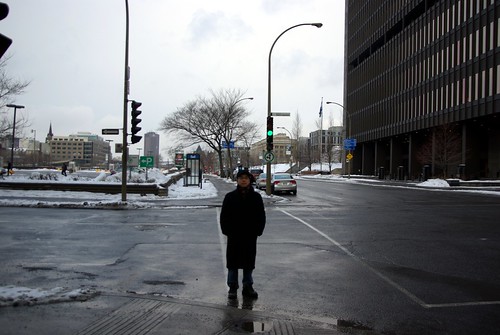
Mon père (un photographe émérite) a pris ces photos de moi devant le bâtiment du journal La Presse, et puis avec au loin la Maison de Radio-Canada derrière mon épaule droite. C'était à l'angle de la rue Saint-Antoine et du boulevard Saint-Laurent.




About Smurfmatic

Smurfmatic is Cedric Sam's weblog. I was born and raised in Montreal, and am of Chinese Cantonese ancestry. The language that I am most fluent in is French, however, while I do my online writings in English. My Chinese? Rather pathetic.
I work in new media. I am a Linux and open-source enthusiast, am amused with taking photos (and videos), am a relative foodie and appreciate this thing we call Chinese indie music. Also a Habs fan.
Reach me at: cedricsam@gmail.com